
Hair Transplant
Hair Transplant in Islamabad – Advanced FUE, DHI & Sapphire FUE Techniques
Restore the appearance of fuller hair with individually planned hair transplantation at Islamabad Clinic. Our hair restoration services include FUE, DHI and Sapphire FUE, natural hairline design, beard and eyebrow transplantation, and selected non-surgical hair therapies.
Every treatment plan begins with an assessment of the donor area, hair-loss pattern, scalp condition, facial proportions and long-term restoration goals. We focus on appropriate technique selection, careful graft handling and natural hair distribution.
- Individualised Hair Restoration Planning
- Advanced FUE, DHI & Sapphire FUE Techniques
- Natural Hairline & Graft Placement Planning
- Consultation and Post-Procedure Guidance
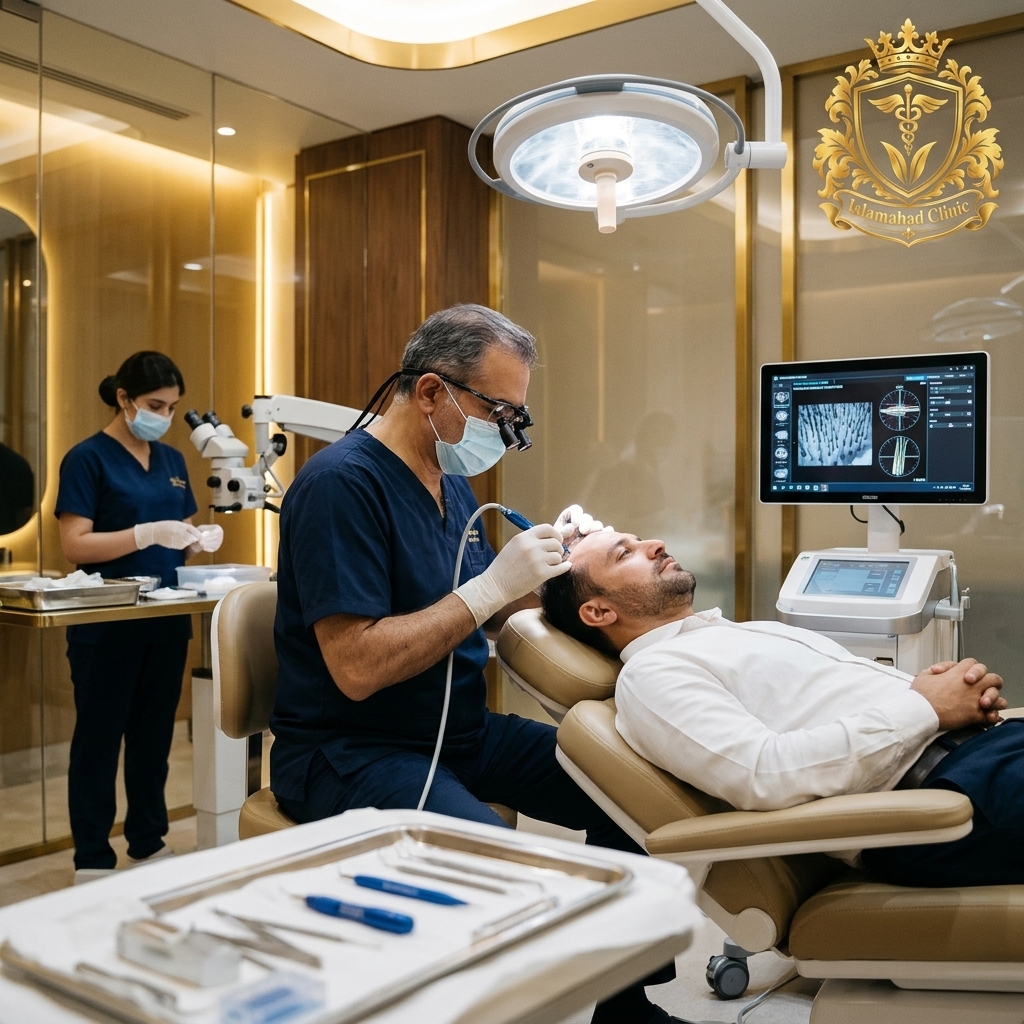
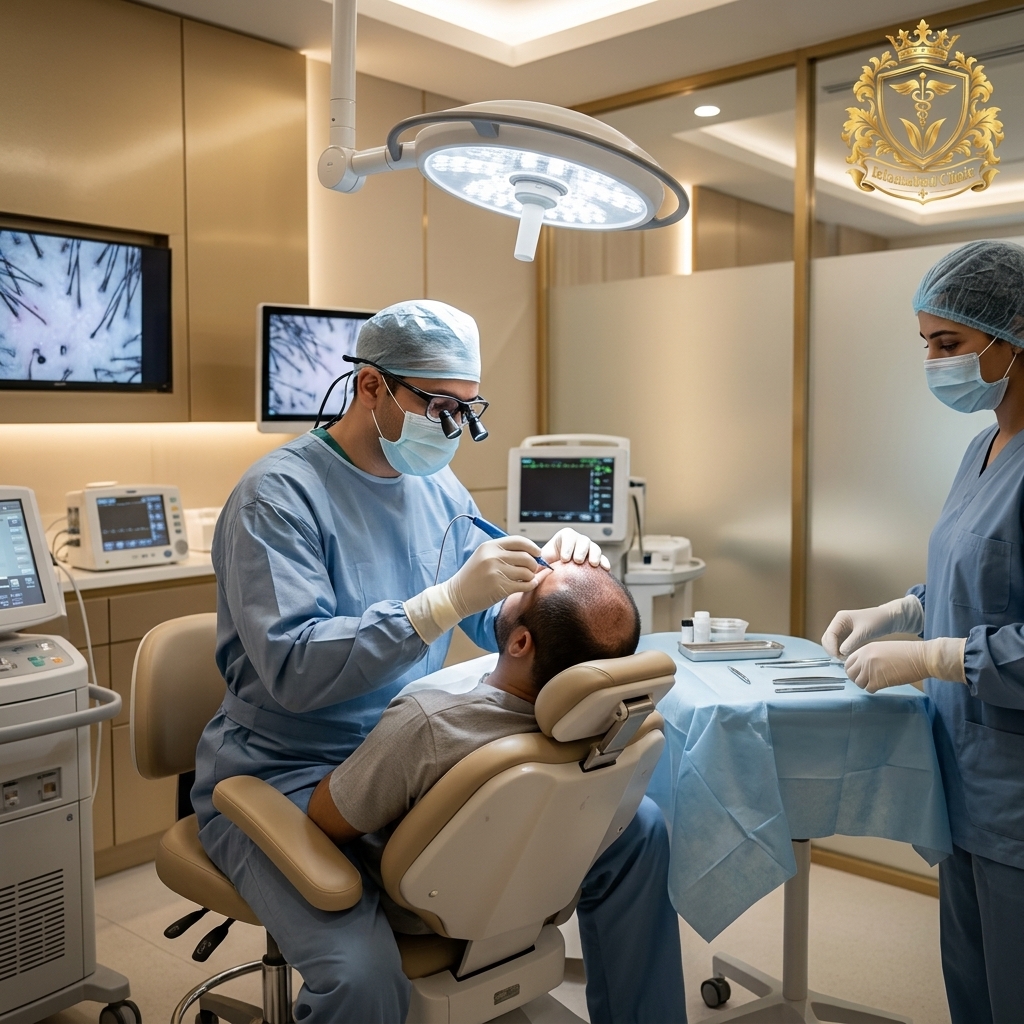
Our most popular technique
FUE Hair Transplant
FUE Hair Transplant,in Islamabad
Follicular Unit Extraction for Targeted Hair Restoration
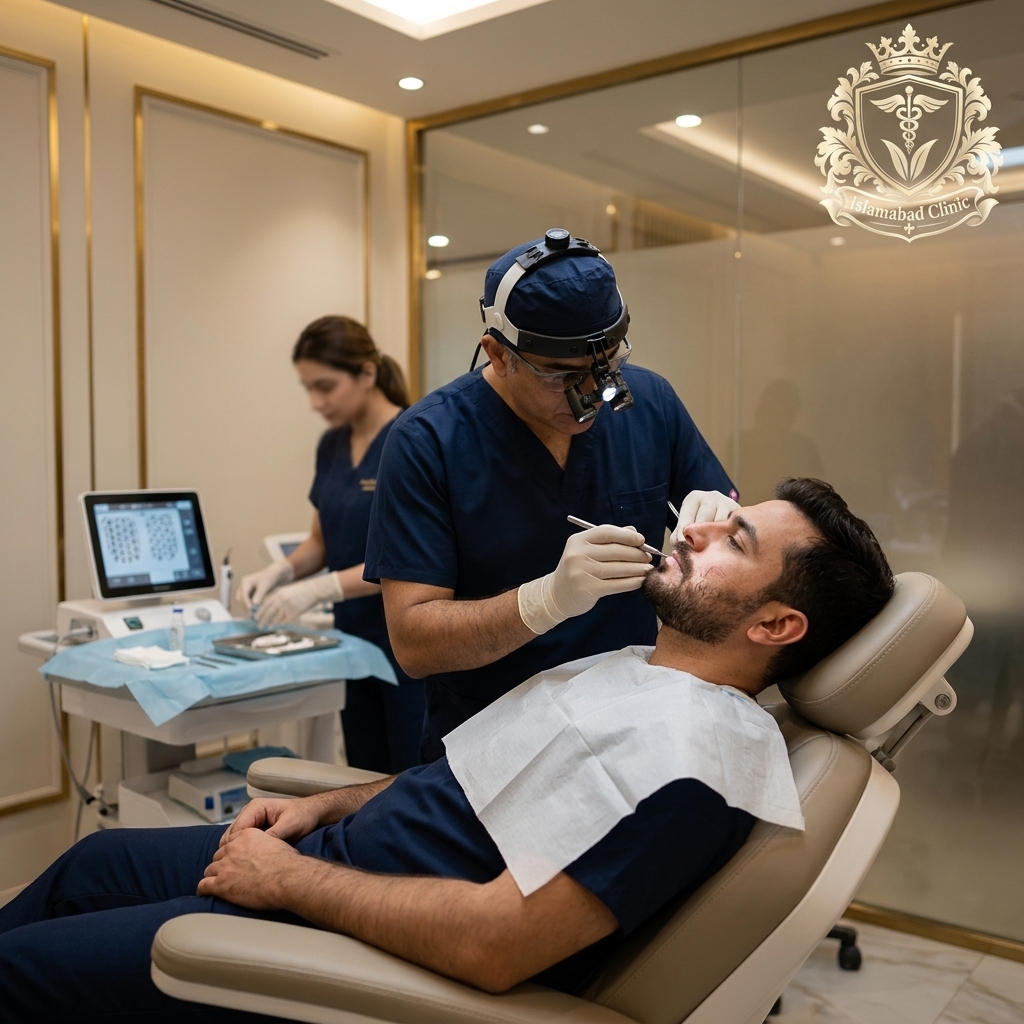
Follicular Unit Extraction (FUE) is a hair transplantation technique in which individual follicular units are harvested from the donor area, usually at the back and sides of the scalp, and transplanted into areas affected by hair thinning or baldness.
Each follicular unit is extracted individually using a specialised instrument. The harvested grafts are then prepared and placed into the recipient area according to the planned hairline, natural hair direction and required distribution.
FUE is commonly considered for patients experiencing androgenetic alopecia, receding hairlines, reduced frontal density and selected areas of crown thinning. Suitability depends on donor capacity, scalp condition, hair characteristics and the extent of hair loss.
- Individual follicular unit extraction
- No linear donor-area incision
- Small punctate extraction sites
- Suitable for selected hair restoration patterns
Individual follicular unit harvesting
Local anaesthesia, when appropriate
Usually the back and sides of the scalp
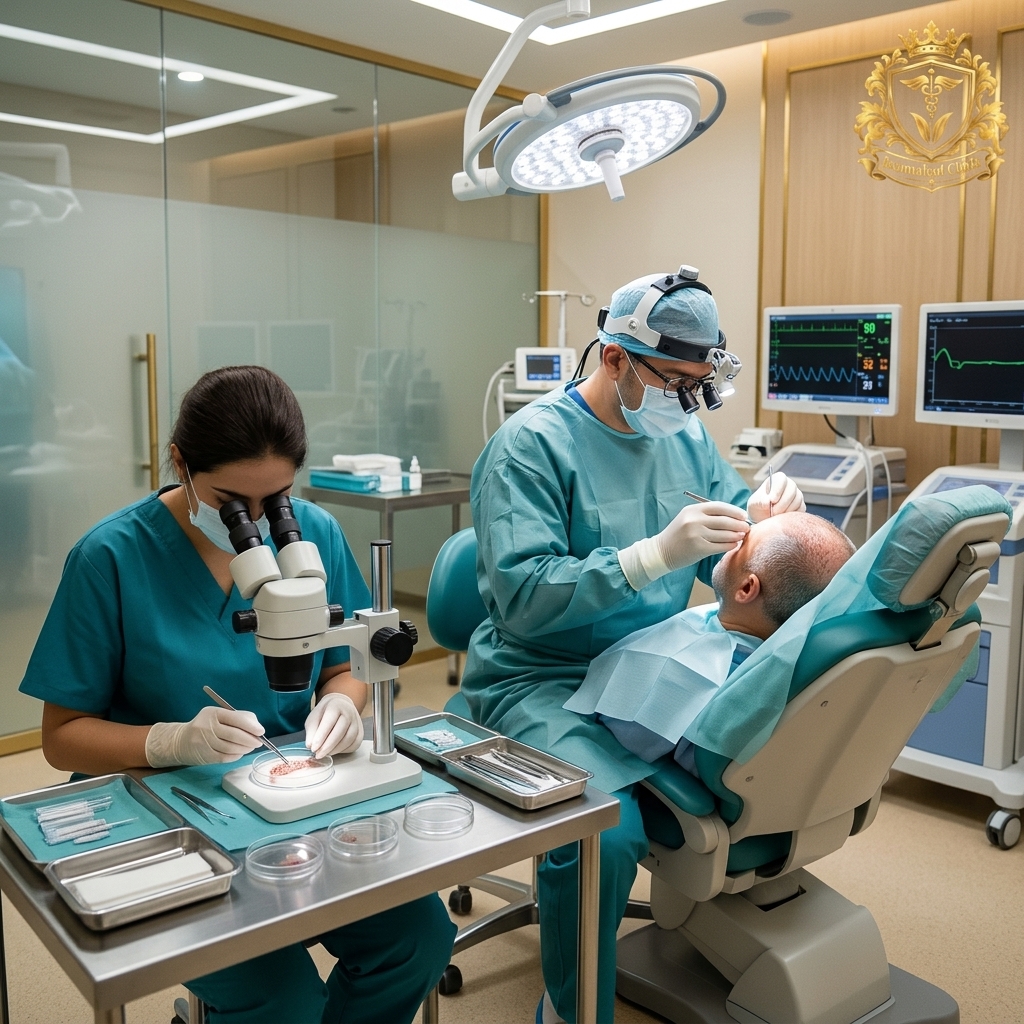
Many grafts in one session
FUT Hair Transplant
FUT Hair Transplant Follicular Unit Transplantation
Strip-Based Graft Harvesting for Selected Patients
Follicular Unit Transplantation (FUT), also known as the strip method, involves removing a narrow strip of scalp tissue from the donor region. The tissue is then dissected under magnification into individual follicular unit grafts for transplantation.
Unlike FUE, which harvests follicles individually, FUT uses strip harvesting and generally leaves a linear scar in the donor area. It may be considered in selected patients depending on donor characteristics, hair-loss pattern, previous procedures and restoration requirements.
The decision between FUE and FUT should be based on a clinical assessment rather than the assumption that one method is universally superior.
- Strip-based donor harvesting
- Microscopic follicular unit dissection
- Potentially useful in selected larger restoration plans
- Linear donor-area scar
Strip harvesting and microscopic graft dissection
Local anaesthesia, when appropriate
Selected scalp donor region
DHI Hair Transplant
DHI Hair Transplant in Islamabad
Precise Graft Implantation Using Choi Implanter Pens
Direct Hair Implantation (DHI) is a hair transplantation approach that uses specialised implanter pens, commonly known as Choi pens, to place prepared follicular unit grafts directly into the recipient area.
The follicular units are generally harvested using an FUE-based extraction process. Each graft is loaded into an implanter pen and positioned according to the planned angle, direction, depth and distribution of the recipient area.
DHI may be considered for selected patients who require focused implantation, frontal restoration or density enhancement. Whether the technique is suitable depends on scalp characteristics, donor availability, hair-loss pattern and the surgeon’s treatment plan.
Donor Extraction
Individual follicular units are harvested from the designated donor area using an appropriate extraction technique.
Graft Preparation
Harvested grafts are inspected, sorted and prepared for implantation while maintaining appropriate handling and hydration.
Direct Implantation
Prepared grafts are placed using an implanter pen according to the planned hair direction, angle and distribution.
Post-Procedure Care
Patients receive instructions regarding scalp hygiene, graft protection, medication where indicated and follow-up.
Important information:DHI does not automatically eliminate shaving, guarantee greater density or suit every patient. The treatment method is selected according to clinical requirements.
Sapphire FUE
Sapphire FUE Hair Transplant in Islamabad
FUE Implantation Using Sapphire-Bladed Instruments
Sapphire FUE is a variation of the FUE hair transplantation approach in which sapphire-bladed instruments are used to create recipient sites for graft placement.
The extraction stage follows the principles of FUE. After harvesting and preparation, the recipient sites are created according to the planned hairline, graft distribution, direction and angle. Sapphire instruments are used for recipient-site creation in selected cases.
The technique requires careful evaluation of scalp characteristics and restoration objectives. The choice of instrument alone does not determine the quality of a transplant; surgical planning, graft handling, placement and clinical expertise remain important factors.
Recipient-Site Planning
The surgeon determines the placement pattern according to the patient’s existing hair, recipient-area characteristics and desired coverage.
Instrument Selection
Sapphire-bladed instruments may be selected for recipient-site creation according to the procedural plan.
Natural Hair Direction
The orientation of recipient sites is planned to follow the natural growth pattern of the surrounding hair.
Is Sapphire FUE suitable for you? A consultation can help determine whether conventional FUE or Sapphire FUE is more appropriate for your scalp and restoration objectives.
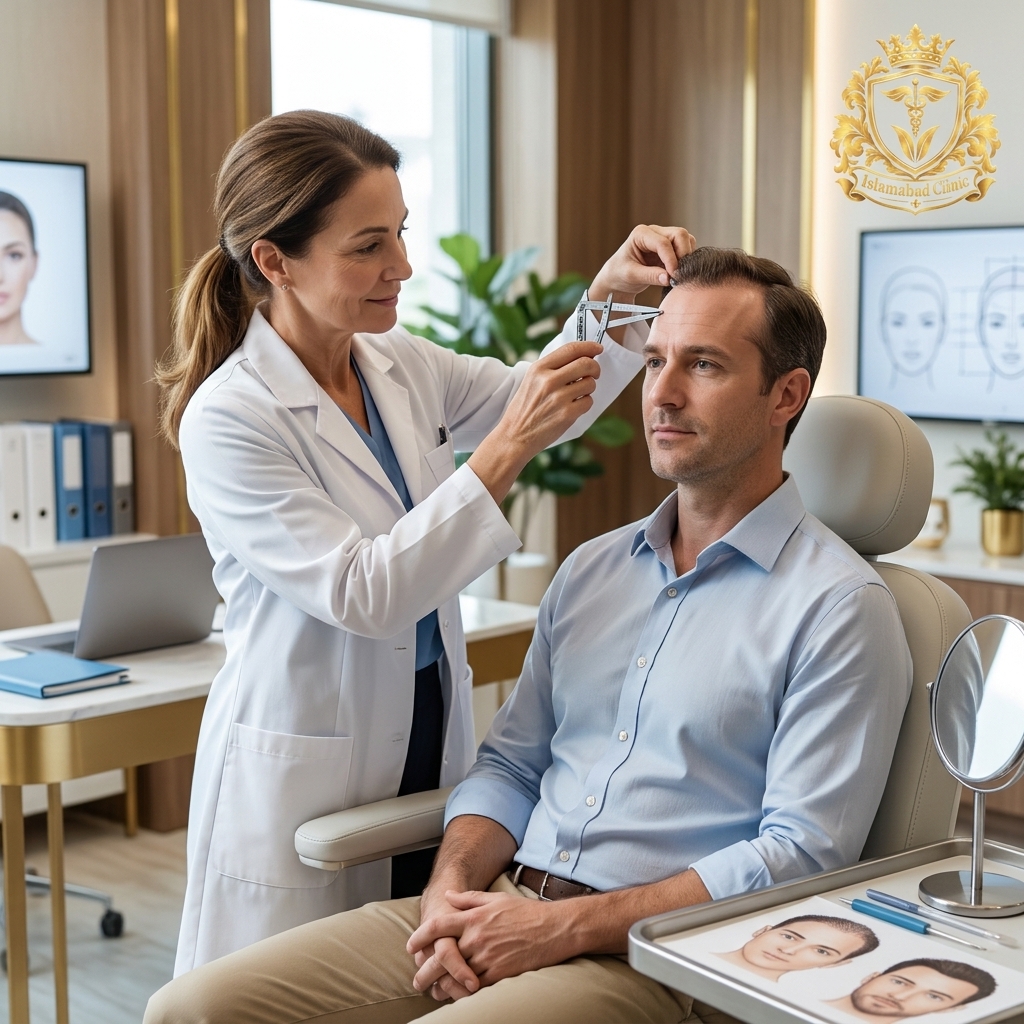
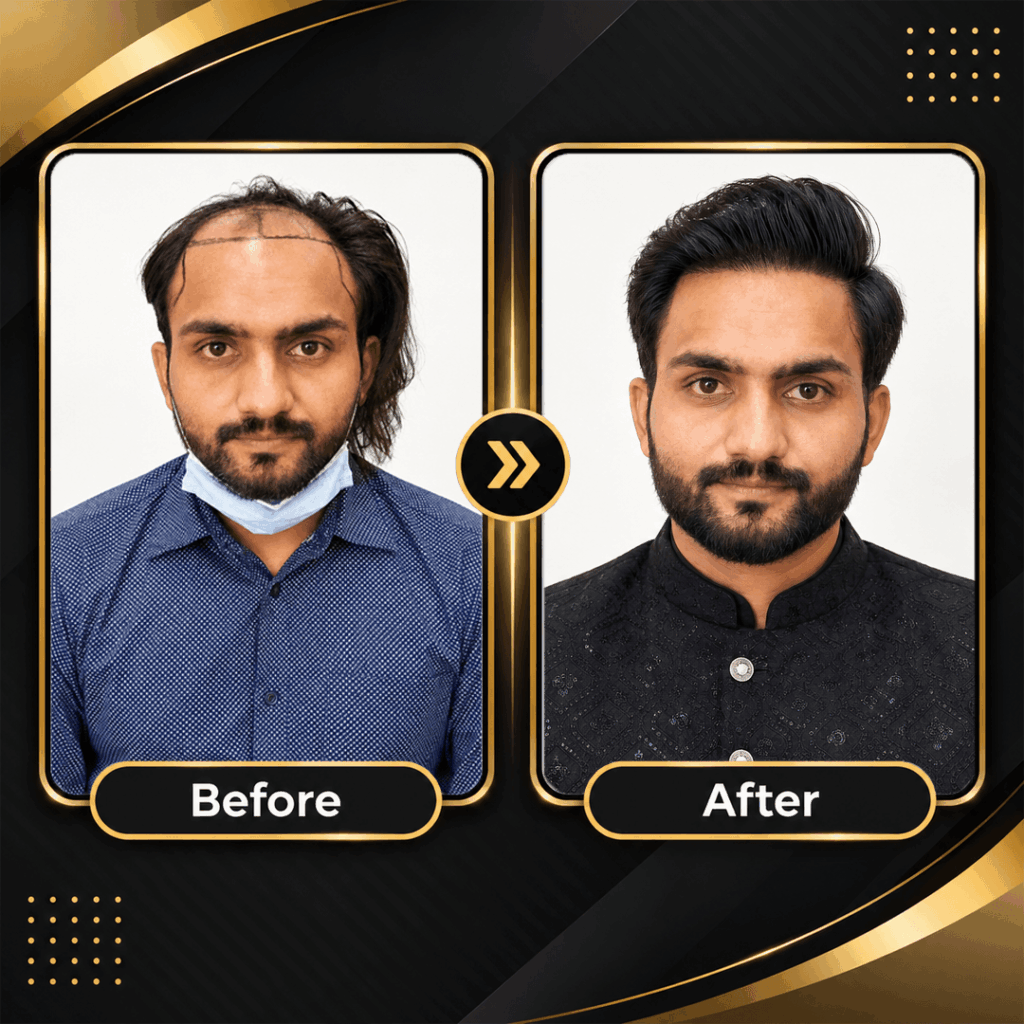
Drawn before your procedure
Hairline Transplant
A Natural Hairline Planned Around Your Facial Proportions
The frontal hairline plays an important role in facial appearance and the overall visual balance of the scalp. Hairline transplantation involves restoring or refining the frontal hairline through carefully planned follicular unit placement.
A suitable design considers facial proportions, age, existing hair characteristics, donor capacity and the potential progression of future hair loss. The objective is to create an age-appropriate and natural-looking transition rather than an artificially straight or excessively low hairline.
The frontal transition zone generally requires careful placement of finer, single-hair follicular units, with graft distribution adjusted across the frontal and posterior regions.
- Receding frontal hairline
- Temporal recession and temple points
- Uneven or asymmetrical hairline
- Selected hairline lowering cases
- Frontal density restoration
- Revision of previously transplanted hairlines
Based on facial anatomy and age
Appropriate follicular units for the frontal transition
Planned according to existing hair and available donor supply
Natural integration with surrounding hair
Design & Specialized
Crown and Temple Hair Transplant
Addressing Specific Areas of Hair Thinning
Hair loss does not affect every part of the scalp in the same way. Some patients experience frontal recession, while others develop thinning at the temples or crown. These areas require different approaches to graft distribution and hair-direction planning.
Crown Restoration
The crown, or vertex, has a distinctive circular hair-growth pattern. Transplant planning must consider the natural whorl, hair direction, existing density and the available donor supply.
Temple Restoration
The temporal regions help define the frontal hairline and frame the face. Restoration requires attention to the natural angle, direction and shape of the temple points.
Revision & Repair Consultation
Patients who have undergone previous hair transplantation may require an assessment of unnatural hairline placement, visible scarring, poor density or irregular graft distribution. Revision procedures require careful evaluation of donor reserves and existing transplanted follicles.
Not every patient is suitable for additional transplantation. A proper assessment is required before recommending a revision or further graft placement.
Natural growth direction
Beard & Mustache Transplant
Beard & Mustache Transplant in Islamabad
Beard and mustache transplantation is a specialized hair restoration procedure used to address sparse, uneven or patchy facial hair. Individual follicular units, commonly harvested from the scalp donor area, are transplanted into selected facial regions.
The procedure requires careful attention to facial anatomy, natural beard growth direction, hair angle and the distribution of existing facial hair. The design may involve the cheeks, jawline, chin, mustache, goatee or sideburns.
- Full beard
- Moustache
- Goatee
- Sideburns
- Patchy areas
- Scars in the beard
Beard Transplant
Fills patchy cheeks, jawline and chin for a fuller, even beard.
Mustache Transplant
Builds a thicker, well-shaped moustache above the lip.
Back of the scalp
Like natural beard hair
Full or partial
Eyebrow Transplant
Eyebrow Hair Transplant in Islamabad
Restore Eyebrow Shape, Definition & Density
Eyebrow transplantation is a specialised procedure designed to improve the appearance of sparse, thin or partially missing eyebrows. Individual follicular units are carefully selected and implanted according to the intended eyebrow shape and natural hair-growth direction.
Because eyebrow hairs grow at very shallow angles and change direction across different sections of the brow, accurate placement is particularly important.
Sparse or Thin Eyebrows
For patients seeking improved fullness in naturally thin or uneven brows.
Over-Plucked Eyebrows
For selected cases in which repeated plucking has contributed to persistent eyebrow thinning.
Scar-Related Hair Loss
For selected eyebrow gaps associated with scars, after assessment of the underlying tissue.
Eyebrow Shape Refinement
A customized design is developed according to facial proportions, existing brow structure and patient preferences.
Before treatment:The eyebrow outline and desired density are discussed and planned.
During treatment:Individual follicular units are positioned according to the planned direction and angle.
After treatment:Patients receive guidance regarding healing, grooming and follow-up.
Non-Surgical Hair Treatments
PRP & Non-Surgical Hair Loss Treatments in Islamabad
Treatment Options for Hair Thinning and Scalp Health
Not every patient experiencing hair thinning requires hair transplantation. Depending on the underlying cause and stage of hair loss, selected non-surgical treatments may be considered to support existing hair follicles and manage certain forms of hair thinning.
Treatment recommendations should be based on an appropriate scalp examination and medical assessment. These therapies have different mechanisms, evidence levels and clinical indications.
PRP Hair Treatment
Platelet-Rich Plasma (PRP) is prepared from a patient’s own blood through a processing procedure that concentrates platelets in plasma. The preparation is administered into selected scalp areas according to the treatment protocol.
PRP may be considered as an adjunctive option for selected patients with hair thinning. Response varies, and multiple sessions may be recommended.
PRGF Hair Treatment
Plasma Rich in Growth Factors (PRGF) refers to a specialised plasma preparation obtained from the patient’s blood. The preparation process and composition differ from conventional PRP protocols.
Its use should be based on the specific preparation system, clinical protocol and available evidence.
Exosome-Based Hair Treatments
Exosome-based products are being investigated for potential applications in hair and scalp treatments. However, clinical evidence, product quality, regulatory status and long-term safety remain important considerations.
Patients should receive clear information about the limitations and evidence supporting any proposed treatment.
Regenerative & Supportive Hair Therapies
Other regenerative approaches may be discussed where clinically appropriate. They should not be presented as established cures for genetic hair loss, and their suitability depends on the specific treatment and evidence available.
Important: : These treatments do not guarantee hair regrowth and cannot replace a medical evaluation of the underlying cause of hair loss.
What to Expect
Hair Transplant Recovery & Growth Timeline
Hair transplantation is a staged biological process. The immediate post-procedure appearance is not the final outcome. Following transplantation, the scalp undergoes an initial healing phase, temporary shedding of transplanted hair shafts and gradual follicular growth.
The timing and degree of visible growth vary between patients and depend on individual healing, graft characteristics and other clinical factors.
What Is a Hair Graft?
A follicular unit graft is a naturally occurring group of hair follicles containing one or more hairs. A graft is not the same as an individual hair. Therefore, the number of grafts and the number of hairs should be considered separately when discussing a treatment plan.
Grafts vs hairs
So 2,000 grafts usually means far more than 2,000 hairs. Always compare plans by grafts and hairs.
Days 1–10: Initial Healing
Small crusts, redness, mild swelling and tenderness may occur around the treated areas. Patients should follow the prescribed washing and scalp-care instructions.
Weeks 2–8: Temporary Shedding
Transplanted hair shafts commonly shed during the early post-operative period. This is often referred to as shock shedding. The follicles may remain within the skin and subsequently enter a new growth cycle.
Months 3–4: Early Growth
New hair growth may begin to appear. Initially, the hairs can be fine and uneven in length or thickness.
Months 6–9: Progressive Development
Hair growth and visible coverage generally continue to develop. Changes in density and hair characteristics may become more noticeable.
Months 12–18: Hair Maturation
Further improvement in thickness, texture and coverage may occur over this period. Crown restoration can sometimes mature more slowly than frontal areas.
Remember: Recovery and growth timelines are individual. The timeline is a general guide, not a guarantee of a particular outcome.
Hair Transplant Questions, Answered
Clear answers to the questions patients ask most about results, side effects and timing.
What is Sapphire FUE?
Sapphire FUE is a variation of FUE in which sapphire-bladed instruments are used to create recipient sites. The extraction process follows FUE principles, while recipient-site creation uses a different instrument. Its suitability depends on individual clinical requirements.
What is the difference between FUE and DHI?
FUE describes a method of harvesting individual follicular units from the donor area. DHI generally uses FUE-based harvesting followed by implantation with a specialized implanter pen. The appropriate method depends on the patient’s scalp, restoration requirements and treatment plan.
Is a hair transplant permanent?
Transplanted follicles are generally harvested from donor regions that are relatively resistant to androgenetic hair loss. They may continue to grow long term, but ageing and progressive thinning can still affect surrounding non-transplanted hair. Individual outcomes vary.
How many grafts will I need?
The graft requirement depends on the size of the recipient area, the extent of hair loss, donor capacity, existing density and desired coverage. An examination is necessary to provide a meaningful estimate.
Does a hair transplant hurt?
The procedure is generally performed under local anesthesia. Patients may experience discomfort during anesthetic administration, and some soreness, swelling or tenderness can occur during recovery. The experience varies between individuals.
How long does a hair transplant procedure take?
Procedure duration depends on the number of grafts, the technique used, the size of the treatment area and individual procedural requirements. The expected duration should be discussed during consultation.
When will new hair growth begin?
Transplanted hair shafts commonly shed during the early weeks. New growth may begin around months three to four, followed by gradual development over subsequent months. Maturation can continue for 12 to 18 months or longer in some cases.
Can women undergo hair transplantation?
Selected women may be suitable candidates. However, the cause of hair loss must be assessed carefully, including the possibility of diffuse thinning, hormonal factors and other medical conditions. Treatment is recommended only after appropriate evaluation.
Can beard and eyebrow hair be transplanted?
Yes. Beard and eyebrow transplantation involve placing individual follicular units into selected facial areas. The procedure requires specialized planning of hair direction, angle and distribution.
Can a previous hair transplant be repaired?
Some patients may be considered for revision procedures to address irregular hairlines, visible scarring, inadequate coverage or unnatural graft placement. Suitability depends on the existing transplant, donor reserves and scalp condition.